

The burnout paradox: Why 2026 is the most exhausted year on record

Burnout Paradox

The Illusion of Progress

Over the last decade, there has been a significant shift from mental health being a "fringe" benefit to a core strategic priority. While many companies previously viewed mental health through the narrow lens of Employee Assistance Programs (EAPs), the data now reflect a more integrated, culture-driven approach.

According to a CIPD report from 2025,

  • The proportion of organizations with a stand-alone wellbeing strategy has increased from 44% in 2020 to 57% in 2025.
  • Nearly three-quarters (74%) of respondents agree that employee wellbeing is on senior leaders’ agendas, up from 61% in 2020.
  • Line manager buy-in to wellbeing is also on the up, from 58% in 2020 to 75% in 2025.

With AI supposedly handling the “boring, hard tasks” and HR departments focusing on building more psychological safety, it is surprising to see data tell a different story. Burnout rates have increased over the last 10 years despite efforts and increased awareness.

2019–2020 (Pre-Pandemic to Early Pandemic): Burnout was mostly localized to high-stress professions (healthcare, law). Rates hovered around 32% to 43% according to Gallup.

Years later, rather than cooling off, rates plateaued or rose as companies pushed for a "return to office" and economic uncertainty increased. Grant Thornton reported that burnout hit 51% in early 2024, a 15-point jump from their previous year's survey.

Today (2025-2026), we are experiencing a new peak, with the 66% figure cited by Grow Therapy and Forbes among US employees.

This is, among other things, attributed to:

  • Employees feel like they have more work to complete than time to do it.
  • Not having enough resources or the right tools to do their job properly.
  • A perception of a poor economy, which is impacting their well-being at work
  • Taking on too much work due to labor shortages in their industry
  • being worried about how AI will impact their role

The “AI ” Trap

The primary culprit of 2026 is the unintended consequence of AI integration. While AI has made individuals more productive, according to a 2025 report from the London School of Economics, up to a full day of work has been saved thanks to AI!

However, instead of reducing the workload, it seems to be increasing it, which Jevons' paradox explains.

Jevons Paradox says that increasing the efficiency with which a resource is used tends to increase (rather than decrease) the rate of consumption of that resource. Basically, the time we save using AI is immediately reallocated to more tasks. Which ultimately means we end up doing more, since we also have to check the AI's work.

This constant need to be available and attentive to every device and tool t also impacts our ability to focus.The Speakwiseapp shared quite terrifying statistics around the human attention span, which decreased from 2.5 min in 2004 to 47 seconds today! We check our phones +250 times a day and are losing our capacity for sustained focus.

You aren’t failing; the system is.

Check out Siffi to access evidence-based resources and a community dedicated to redefining what "healthy work" looks like in 2026.

The Wellness “Tick-Box” Culture

A majority of employers are now investing in tools, but not all of them are actually putting in the work for structural change. The Mental Health UK Burnout Report 2026 notes that while 29% of employers raise awareness, managers often lack the training or time to provide meaningful support.

Almost one in five (18%) said mental health is treated as a tick-box exercise at work, while just one in four (27%) workers said mental health is genuinely prioritized and supported through action and resources.

It looks like while the will is there, the time and skills are still lacking in many teams to properly and actively change the way we work.

This constant need to be available and attentive to every device and tool t also impacts our ability to focus.The Speakwiseapp shared quite terrifying statistics around the human attention span, which decreased from 2.5 min in 2004 to 47 seconds today! We check our phones +250 times a day and are losing our capacity for sustained focus.

Moving beyond the "tick-box".

Transitioning from awareness to a genuine wellbeing culture requires a strategic roadmap. Explore more on How to develop a mental wellbeing culture in your company to start making structural changes that actually reduce burnout.

Gen Z at the Breaking Point

The crisis seems to be hitting the younger members of the workforce the hardest. Millennials and Gen Z both experience burnout way earlier than older generations, too, around 25 against 42 for the average American.
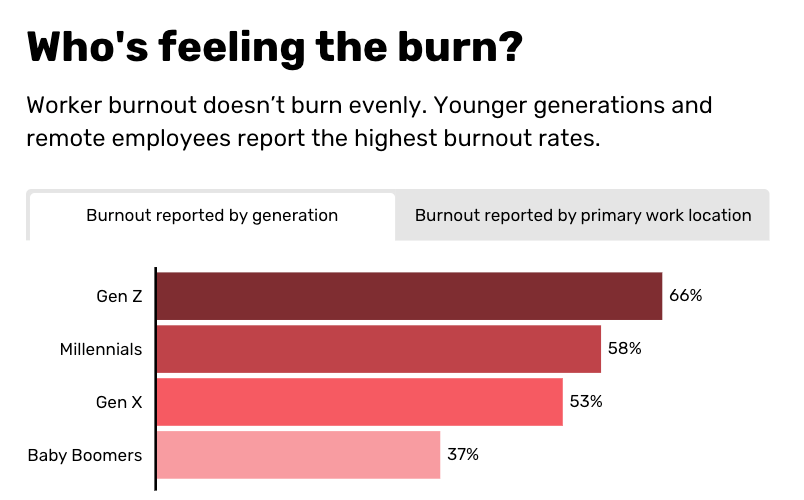
If 2026 has taught us anything, it’s that you cannot “app” your way out of a toxic work structure. Burnout is an occupational phenomenon, as defined by the World Health Organization, not an individual failing.

For the rate to drop, the focus must shift from “helping employees cope with stress” to “removing the sources of stress” within the organization's design. There are many ways to do that. We are here to help!

Frequently Asked Questions

While awareness and “perks” have increased, the underlying structure of work has become more intense. The integration of AI has often led to “productivity debt,” where employees are expected to do more in less time, leading to a constant state of high-pressure output that overrides the benefits of wellness tools.

The AI Trap refers to the unintended consequence in which AI-driven efficiency gains are immediately offset by more tasks. Instead of reducing hours, AI often increases the volume of work and the “mental load” of supervising automated outputs, leading to a phenomenon known as Jevons Paradox.

Data suggests that Gen Z reaches burnout earlier (around age 25) than previous generations (average age 42). This is driven by high economic uncertainty, “AI anxiety” regarding entry-level job security, and a digital-first work culture that makes it difficult to “switch off.”

Authentic support requires moving from individual coping to systemic change. This includes training managers specifically on psychosocial risk, reviewing workloads to ensure they are sustainable, and using AI tools to create “breathing room” rather than just more capacity.

About the author

Morgane Oleron

Morgane Oléron

Psychology Content Writer at Siffi

Morgane crafts compassionate, engaging content that makes mental health conversations more human and accessible. At Siffi, she combines storytelling with strategy to foster a culture of care and connection in the workplace.

Recent Posts

How ready is your organisation?

Take a quick self-assessment to discover where your company stands on mental health readiness

State of Workplace
Wellbeing Report

Benchmark data from 50+ organisations on mental health utilisation, ROI, and what actually drives employee engagement.

Please enter a valid email